Rock Simfonic Grup muzical & Cântăreţ Listă

Progressive rock (shortened as prog rock or simply prog) is a broad genre of rock music that primarily developed in the United Kingdom through the mid- to late 1960s, peaking in the early-to-mid-1970s. Initially termed "progressive pop", the style emerged from psychedelic bands who abandoned standard pop or rock traditions in favour of instrumental and compositional techniques more commonly associated with jazz, folk, or classical music, while retaining the instrumentation typical of rock music. Additional elements contributed to its "progressive" label: lyrics were more poetic, technology was harnessed for new sounds, music approached the condition of "art", and the studio, rather than the stage, became the focus of musical activity, which often involved creating music for listening rather than dancing.
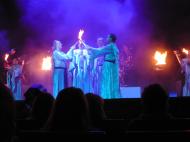
Progressive rock includes a fusion of styles, approaches and genres, and tends to be diverse and eclectic. Progressive rock is often associated with long solos, extended pieces, fantastic lyrics, grandiose stage sets and costumes, and an obsessive dedication to technical skill. While the genre is often cited for its merging of high culture and low culture, few artists incorporated classical themes in their work to a significant degree, and only a handful of groups, such as Emerson, Lake & Palmer and Renaissance, intentionally emulated or referenced classical music.
In the early-to-mid-1970s, progressive rock groups such as Pink Floyd and Yes experienced great worldwide success; in the late 1970s, it declined in popularity, and has never fully recovered. Conventional wisdom holds that the rise of punk rock caused this, but several more factors contributed to the decline. Music critics, who often labelled the style of progressive rock as "pretentious" and the sounds as "pompous" and "overblown", tended to be hostile towards the genre or to completely ignore it. After the late 1970s, progressive rock fragmented into numerous forms. Some bands achieved commercial success well into the 1980s (albeit with changed lineups and more compact song structures) or crossed into symphonic pop, arena rock, or new wave.
Early groups who exhibited progressive features are retroactively described as "proto-prog". The Canterbury scene, originating in the late 1960s, denotes a subset of progressive rock bands who emphasised the use of wind instruments, complex chord changes and long improvisations. Rock in Opposition, from the late 1970s, was more avant-garde, and when combined with the Canterbury style, created avant-prog. In the 1980s, a new subgenre, neo-prog, enjoyed some commercial success, although it was also accused of being derivative and lacking in innovation. Post-progressive draws upon newer developments in popular music and the avant-garde since the mid-1970s.
Citește mai mult...




Reguli de Vot
- Puteți vota în sus sau în jos. Vă rugăm să ia în considerare întotdeauna contextul în care vot, de exemplu, un cântec ar trebui să fie votat în sus sau în jos cu privire la alte melodii incluse pe album, performanța unui actor în comparație cu alți actori din acelasi film, o carte cu privire la alte cărți de același autor sau în același gen.
- Un vot poate fi anulată printr-un simplu clic pe votul opus în termen de 24 de ore. Puteți vota apoi din nou pe același element.
- Fiecare utilizator are un vot pentru fiecare element într-o listă specifică la fiecare 24 de ore. După 24 de ore se poate vota din nou pe același element în aceeași listă.
- Puteți vota la cât mai multe elemente cum vă place într-o listă sau pe același articol în cazul în care este parte din altă listă. De exemplu, puteți vota David Bowie în sus sau în jos pe lista de artiști de muzică pop, precum și pe lista artiștilor de indie rock și pe lista de muzica rock artiști, etc
- Votul fericit!